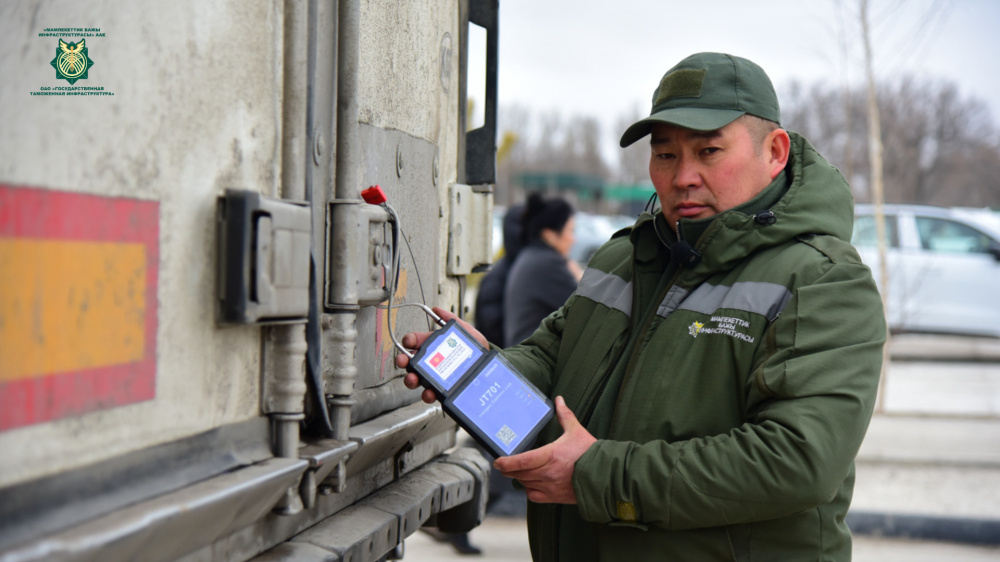
I. Policy Tailwind: Technical Response Under EAEU Unified Regulatory Framework
Effective February 11, 2026, the Eurasian Economic Union (EAEU) formally mandated navigation seals as compulsory regulatory tools for cross-border freight. As a key member state, Kyrgyzstan took the lead in responding to this regional integration policy, launching a national cargo tracking mechanism.
The first batch of goods subject to mandatory tracking covers alcoholic beverages, tobacco products, and commodities under special economic measures, spanning both road and rail transport scenarios. This policy pivot signals a paradigm leap for EAEU regional customs supervision—from "port inspection" to "in-transit control"—opening a policy window for large-scale deployment of intelligent logistics technologies.
II. Pain Point Diagnosis: Efficiency Dilemmas of Traditional Oversight
Before the navigation seal system took root, Kyrgyzstan and regional customs authorities grappled with multiple operational bottlenecks:
Information Black Box During cross-border transit, cargo status remained virtually invisible to regulators, creating regulatory vacuum zones lasting days or even weeks.
Human Intervention Dependency Heavy reliance on manual escort and physical inspection not only drove up administrative costs but also proved inadequate for growing trade volumes given limited human resources.
Post-Event Risk Exposure Anomalies such as smuggling, cargo diversion, and unauthorized seal breaches were typically discovered only upon port arrival, lacking mid-journey interception capabilities.
Friction Costs at Clearance Repeated inspections and paper-based documentation flows caused border congestion, pressuring both logistics timelines and trade costs.
III. Technical Breakthrough: Jointech ECTS Full-Stack Solution
Addressing these pain points, we crafted a tailor-made ECTS intelligent freight supervision architecture covering "device-edge-cloud" for Kyrgyzstan:
GPS Navigation Seal: Precision-engineered for cargo compartment structures, embedded with multi-constellation positioning modules enabling meter-level trajectory reconstruction
GPS Electronic Lock Control: The lock body itself serves as sensor—opening status and location data transmitted synchronously, integrating physical security with digital tracking
Platform Hub Layer: Visualized Command Brain
A centralized monitoring center operating 24/7/365, aggregating freight data across the entire road network. Regulators gain panoramic visibility of cross-border cargo flows through a single dashboard, with abnormal events triggering automatic pop-up alerts by severity level.
Core Capability Matrix
Capability Dimension
Functional Description
Global Tracking
Seamless trajectory continuity across borders and transport modes
Geo-Fencing
Route deviation from preset corridors triggers instant alerts, eliminating "leakage and diversion"
Tamper Detection
Millisecond-level response to unauthorized opening with immediate evidence chain solidification
Intelligent Assessment
Risk profiling based on historical data to assist targeted deployment
IV. Deployment Pathway: From Pilot Validation to Network Coverage
Phase One: Corridor Pilot
Selected the Kyrgyzstan-Kazakhstan-Russia cross-border corridor for initial deployment, validating technical reliability and operational adaptability in live business flows.
Phase Two: Node Weaving
Established installation service points at critical border crossings and logistics hubs including Ak-Zhol, Ak-Tilek, Chaldybar, Chon-Kapka, and Karkyra, constructing a "port + hinterland" dual-layer service network.
Phase Three: System Integration
Full tracking data integration into the national customs informatization platform, enabling data sharing and business synergy across tax, traffic management, and foreign trade departments.
V. Value Unleashed: From Regulatory Efficiency to Trade Ecosystem Optimization
For Regulators
regulatory purview expanded from "points" to "lines"; cross-border collaboration evolved from "information silos" to "real-time interconnectivity"


 Your message must be between 20-3,000 characters!